
What Are Uncut Pages in a Book? Uncut vs. Unopened, Explained
Two words that collectors use carefully and everyone else uses interchangeably. One describes the edge of a book. The other describes whether you can turn the page at all.
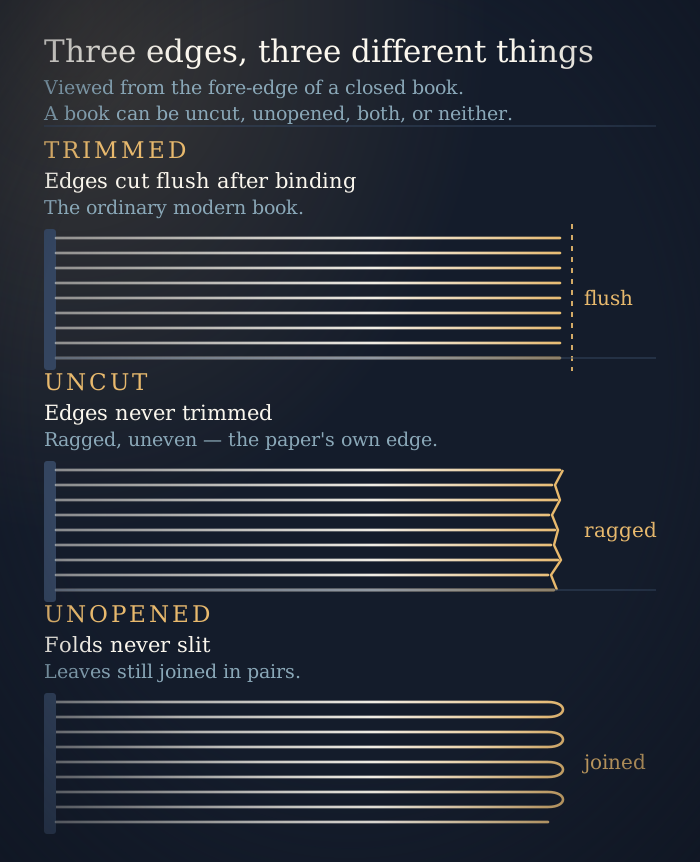
An uncut book has page edges that were never trimmed smooth after binding — uneven, sometimes feathered, the way the paper came out of the mould. An unopened book is a different thing entirely: its folded leaves were never slit apart, so some pages still cannot be turned. A book can be uncut, unopened, both, or neither. The two words get swapped constantly, including by people selling books.
The distinction is old and narrow and worth about four minutes of your time — unless you are holding a book that is one of them, in which case it is worth rather more.
Uncut and Unopened Are Not the Same
Uncut is about the edges. After the pages are sewn together, a binder normally trims the three outer edges flush. Skip that step and the book is uncut: the edges stay uneven, showing where each sheet of paper actually ended.
Unopened is about the folds. Pages arrive at the binder as large folded sheets, and folding leaves closed edges where the paper turns back on itself. If nobody slits those folds, the leaves stay joined in pairs.
For a reader the difference is blunt. An uncut book can be read straight through. An unopened book cannot — you will reach a page, try to turn it, and find it is attached to the next one.
The two states travel together often enough to explain the confusion. Trimming a text block is what opens most of those folds, so a book that escaped the trimming usually escaped the opening as well. They are still different claims, and if you are the one buying, the difference is money.
How a Book Got That Way
A printer laid out several pages on one large sheet, arranged so that folding it put them in reading order. Fold once and you have a folio. Fold twice, a quarto. Three times, an octavo — the format most old novels arrive in.
Each folded sheet is a gathering. Gatherings are sewn together, and the sewn block is bound. Near the end of that sequence the binder takes a blade to the three outer edges and levels them, which is the step that both squares the book and slits open whichever folds the format left closed — in an octavo, the head and the fore-edge.
Into the early nineteenth century that step often belonged to the buyer rather than the publisher. Books were sold as loose sheets, or in plain paper boards meant as a temporary cover, and you took yours to a binder to be finished to match the rest of your shelf. A copy that never made that trip is a copy that never got trimmed.
That is not the only route to an untrimmed edge, and assuming it is will date a book badly. Publishers' cloth arrived in the 1820s and 30s and took the decision back from the buyer, but plenty of houses kept issuing books untrimmed on purpose long after — French publishers as a matter of routine well into the twentieth century, and the English private presses, for whom an edge nobody had levelled was part of the point. If you are holding a French paperback with its folds still closed, nothing went wrong. That is how it was sold.
What a Deckle Edge Is — and What It Isn't
Handmade paper was formed in a mould with a removable wooden frame sitting on top, called the deckle. Pulp seeps slightly underneath that frame, so the sheet dries with a soft, feathered border. That border is a deckle edge, and no blade produced it.
Leave a book untrimmed and the deckle edges stay visible, which is why the two terms sit so close together: a deckle edge is often what an uncut edge looks like.
Modern printing complicates it. Plenty of new hardbacks are sold with a rough fore-edge manufactured to look that way — cut, then torn or milled for effect. It is a design decision, and a pleasant one, but it is decoration rather than evidence. A ragged edge on a book printed last year tells you about the publisher's taste and nothing about the book's history.
Should You Slit an Unopened Book?
Probably not, and not by yourself.
An unopened gathering is one of the few pieces of physical evidence a book carries about its own life. Those particular leaves were not read. That is not proof the whole book went unread — other gatherings may be open, and someone may have read as far as the fold and stopped — but for those pages it is about as direct as evidence gets.
Slitting is a one-way decision, easy to do badly, and a torn fore-edge is worth considerably less than a closed one. Paper knives exist for the purpose, and libraries do open leaves deliberately, but that is a decision made by someone who already knows what the copy is.
If you think you have one, ask a rare-book dealer, a conservator, or a special-collections librarian — before you ask a drawer for a letter opener.
Do Uncut Pages Make a Book Worth More?
Sometimes, and not reliably enough to plan on.
An untrimmed edge sits alongside edition, scarcity, condition, completeness, and who happens to be collecting that particular title. For some books it matters a great deal: an uncut copy can show that this one escaped a later rebinding, which on a first edition is real money. For others it means only that the copy was never finished, and a clean trimmed one will outsell it.
The ragged edge is information. It is not automatically a price.
Why the Bookshop Is Called Uncut Pages
A shop named for a state of incompletion is a slightly odd thing to put on a sign, and that is most of why I liked it.
An uncut book is one that was never squared off to match the others. Nothing was shaved away to make it sit flush beside its neighbors, so the shape the paper arrived in is still there to be read.
The trade has a word for a copy nobody has improved — not rebound to look grander than it is, not made up with leaves borrowed from another copy, not washed and pressed into a condition it never earned. The word is unsophisticated, and it is meant as praise. An untrimmed edge is one of the plainest signs of it, though it is a sign and not the thing itself: a properly trimmed book can be unsophisticated too.
I put a shop with that name in a town where nearly everything has been sophisticated a little — edges taken down, corners squared, the version of the story that fits the shelf. The rare-books room at the back holds the ones that never were.
Questions People Ask
- Can a modern book have uncut pages?
It can be sold with an untrimmed or artificially deckled fore-edge, which looks the part. Genuinely unopened folds are rare in modern commercial printing, where trimming is part of the machine.
- Is "uncut" the same as "untrimmed"?
They describe the same physical state. Careful cataloguers tend to prefer untrimmed, for exactly the reason this article exists: uncut keeps getting read as unopened.
- How do I tell whether a book is unopened rather than just stiff?
Look along the fore-edge and the head for a continuous fold — the paper turning back on itself in one closed curve, instead of two separate leaf edges sitting side by side. If it looks like a fold, stop there and ask someone before you open it.
In The Last Wednesday, a free prequel novella to The Uncut Pages Bookshop Mysteries, an old book is left on the bookshop doorstep at dawn with no note attached. The terminology in this article is real. The harbor it turns up in is not, and the novella is free.
Uncut Pages, the first full-length book in the series, arrives at the end of summer 2026.